
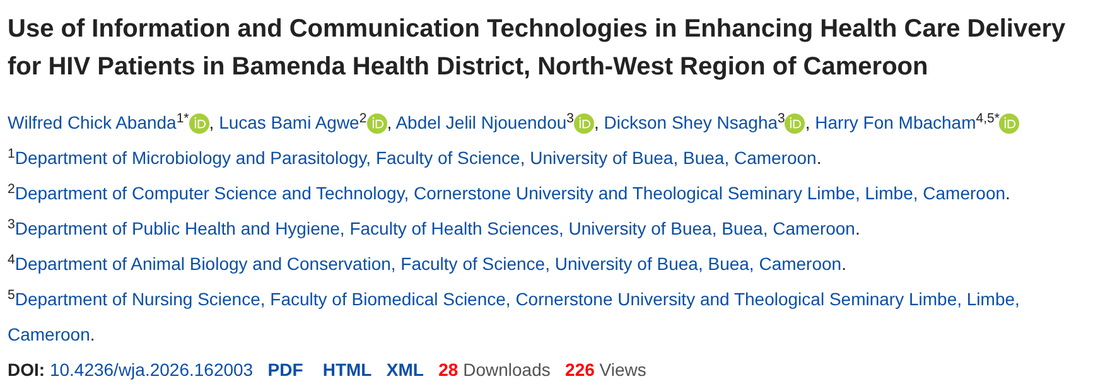
We are pleased to share a recently published research paper titled:
“Use of Information and Communication Technologies in Enhancing Health Care Delivery for HIV Patients in Bamenda Health District, North-West Region of Cameroon” by Wilfred Chick Abanda, Lucas Bami Agwe, Abdel Jelil Njouendou, Dickson Shey Nsagha, and Harry Fon Mbacham.
The study appears in World Journal of AIDS (2026) and two of its authors write from this institution: Lucas Bami Agwe of the Department of Computer Science and Technology, and Harry Fon Mbacham of the Department of Nursing Science, Faculty of Biomedical Science, both at our Limbe campus.
The question it asks is a practical one. Digital tools are supposed to make HIV care easier to deliver, so are they actually being used in the wards and consulting rooms of the Bamenda Health District, and if not, what is standing in the way? The team put that question to 388 people: 263 patients living with HIV, and the health personnel who care for them, drawn from public and private facilities across the district.
Key Findings
- 57.0% of patients had received a text message or alert reminding them when to take their medication, which makes the simple SMS the most useful digital tool in the study.
- Only 22.8% said a computer was used during their consultation, and 45.6% had used at least one digital tool to reach a health worker when they needed to.
- Almost every health worker, 97.6%, used some digital tool in caring for HIV clients. Even so, 41.6% were still writing patient records into paper logbooks and reading them back out again.
- For keeping patient records, Dama was the tool named most often (25.6%). For working with the data afterwards, staff reached for Excel (32.0%) and DHIS2 (22.4%), while SPSS was the least used at 2.4%.
- Asked what they would like to be trained on, health workers named DHIS2 (23.2%) and Dama (18.4%) first.
What Is Standing in the Way
Patients and staff named different obstacles, and neither list is about willingness.
- Patients: no device to use (76.8%), poor network coverage (54.4%), and the price of data bundles.
- Health personnel: no training on the tools (68.8%), no electricity (60.8%), and again the price of data.
Why This Matters
A patient who is reminded to take a dose is a patient more likely to take it, and a record that lives in a system rather than a logbook is a record the next clinician can actually find. That is the promise of digital health, and this study is a careful account of how far the Bamenda Health District has come towards it and how much of the distance is left.
What stands out is that the barriers are not attitudes. Staff want the training and named the tools they want it on. Patients use what they can reach. What is missing is power, network, devices and instruction, which are matters of investment rather than persuasion. The authors accordingly ask the Ministry of Public Health to strengthen the implementation of the National Digital Health Strategic Plan, with real investment in ICT infrastructure inside health facilities and continuous training on DHIS2, electronic medical records and telemedicine.
Our congratulations to Mr. Agwe and Mr. Mbacham, and to their co-authors at the University of Buea.
Access this paper through the link: https://doi.org/10.4236/wja.2026.162003
Citation
Abanda, W.C., Agwe, L.B., Njouendou, A.J., Nsagha, D.S. & Mbacham, H.F. (2026). Use of Information and Communication Technologies in Enhancing Health Care Delivery for HIV Patients in Bamenda Health District, North-West Region of Cameroon. World Journal of AIDS, 16, 29–45. doi: 10.4236/wja.2026.162003